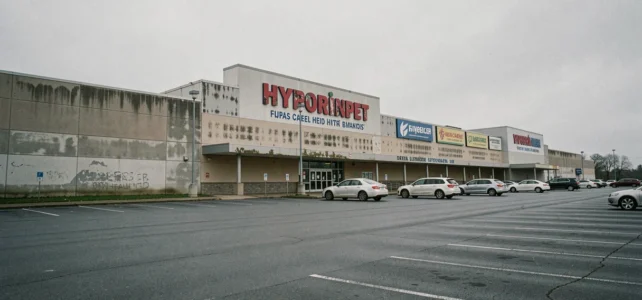
The Cora brand has officially ceased to exist under its historical name following Carrefour’s acquisition of the entire Cora and Match network in France. This disappearance is not merely a change of logo on a façade. It illustrates the collapse of a business model, that of the very large general hypermarket, and opens a phase of reorganization whose effects are already being felt on the ground, both for employees and the affected territories.
Antitrust constraints and divestitures imposed by the Competition Authority
The acquisition of Cora and Match by Carrefour did not occur without regulatory conditions. The French Competition Authority required the divestiture of six hypermarkets to avoid excessive concentration in certain trading areas. This point is often overlooked in narratives centered on nostalgia for the brand, even though it directly shapes the local commercial landscape.
See also : Discover the detailed map of highways in France with tolls and rest areas
These divestitures mean that stores once branded Cora will not fall under Carrefour’s banner but will be taken over by other brands or independent groups. The disappearance of Cora does not simply result in a transfer to a single player: it fragments the network and redistributes the cards among several operators. The details of the buyers site by site, documented by cora wikipedia on Com Unic, show the extent of this structured reorganization.
For the employees affected by these divestitures, uncertainty surrounds the applicable collective agreements after the change of employer, the maintenance of social benefits, and the sustainability of positions in structures often smaller than the former hypermarket.
Further reading : Discover the secret coves and beaches of Lake Bourget for an unforgettable summer
The giant hypermarket model: why Cora did not survive
Pierre-Alexandre Billiet, CEO of Gondola, summarizes the situation directly: hypermarkets over 12,000 m² are very difficult to manage and very hard to make profitable. This model has been considered outdated for nearly a decade.
Cora, founded in 1969 by the Belgian group Louis Delhaize, built its network on this promise of vastness. Large retail spaces, a very wide assortment, a suburban location designed for cars. The problem is that consumer habits have shifted towards e-commerce, hard discounting, and short supply chains, without the brand managing to pivot.

Unlike Delhaize, which has undergone a profound (and painful) restructuring to reposition itself, Cora never undertook a reorganization of comparable scale. The Louis Delhaize group maintained a wait-and-see strategy, betting on the resilience of the historical format. This inertia accelerated the erosion of market share, year after year, in the face of competitors who were investing heavily in drive, digital, and proximity formats.
The aggressive arrival of Asian e-commerce has added further pressure on non-food categories, historically profitable for hypermarkets. Housewares, electronics, textiles, these departments that ensured the margin, have seen their foot traffic decline in favor of online platforms.
Former Cora sites: the transformation into multi-brand commercial hubs
The Cora buildings are not left vacant. In Belgium, the Anderlecht site has already hosted Delhaize and then Aldi. Other locations are announced in Woluwe-Saint-Lambert and Charleroi. What emerges is no longer a single hypermarket, but a fragmented commercial hub bringing together several specialized brands.
This pattern is repeating across several sites. Where a single operator once occupied more than 10,000 m², we now find:
- A medium-sized grocery store (Aldi, Delhaize, or others), designed for daily foot traffic rather than for weekly bulk shopping
- One or more specialized brands (electronics, sports, DIY) occupying the wings or adjacent galleries
- Proximity services (health, fast food, coworking) that attract a regular flow without relying solely on the act of purchase
The unique hypermarket gives way to a hybrid multi-brand site. This model has a structural advantage: the failure of one tenant does not jeopardize the entire site. The commercial risk is spread out, and landlords have a flexibility that the single-operator format did not allow.
The available data does not yet allow for conclusions about the medium-term profitability of these conversions. Initial feedback shows rapid openings, but the question of the overall customer flow, which sustained the shopping galleries attached to Cora, remains open.
Social and territorial impact of Cora’s disappearance
In Belgium, the closure of the seven Cora supermarkets scheduled for early 2026 concerns nearly 1,800 jobs. The magnitude of the shock has led European authorities to propose emergency financial support to assist laid-off employees.
The social repercussions have also been discussed in the Walloon Parliament, a sign that the disappearance of Cora goes beyond a simple market operation. In the affected employment basins, the hypermarket often represented the first local private employer. Its closure impacts subcontractors, regional suppliers, and businesses in the adjacent shopping gallery.
In France, the situation is different: the stores are transitioning to the Carrefour brand, which preserves some jobs. Trade unions remain vigilant about the conditions of the transition, particularly regarding redeployments and any potential job cuts related to geographical overlaps between former Cora and existing Carrefour stores.
The disappearance of Cora acts as a revealer. It shows that the large retail sector in France and Belgium is entering a phase where the size of a store is no longer an asset but a liability. The brands that survive are those that have managed to reduce their spaces, diversify their formats, and integrate digital before being forced to do so.
For the territories, the real question is not which brand will replace Cora, but whether the model of the suburban commercial zone centered around a single giant still has a future.