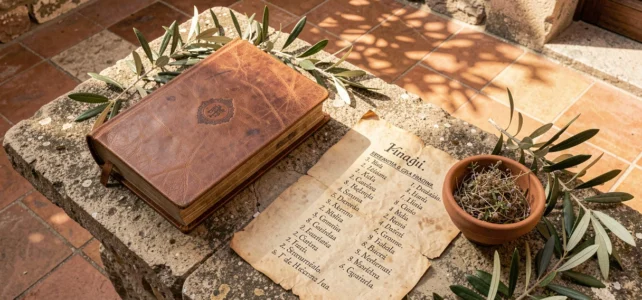
Italian biblical names combine two heritages: the musicality of the Italian language and the symbolic weight of sacred texts. In Italy, the majority of the most commonly given names remain rooted in Christian and biblical tradition. This selection of twenty names blends well-known classics with rarer forms, all endowed with a strong meaning for a child with a symbolic name.
1. Gabriele

See also : What amount to give your nephew for a successful wedding gift?
Gabriele is the Italian form of Gabriel. It means “God is my strength” in Hebrew. In the Bible, Gabriel is the archangel messenger who announces decisive births.
This name is among the most given in Italy in recent years. It also works very well in France, where Gabriel tops the charts. Choosing the Italian version allows one to stand out while retaining a universally recognized root.
See also : Tips and Advice for a Fulfilling Family Life Every Day
2. Matteo
Matteo descends from the Hebrew Mattityahu, “gift of God.” The apostle Matthew, author of the first gospel, bore this name in its Aramaic form. The Italian version retains an open sound, with its characteristic -eo ending.
This name is stable in the Italian rankings, carried by successive generations without a sudden fashion effect. For parents looking for ideas for biblical Italian names that are both common and profound, Matteo remains a safe bet.
3. Samuele

Samuele comes from the Hebrew Shemu’el, “his name is God” or “God has heard.” In the Old Testament, Samuel is the prophet who anoints the first kings of Israel.
Samuele appears in the top 20 of male names in Italy, confirming its popular grounding. Its four-syllable pronunciation gives it a melodic rhythm that lends itself well to diminutives (Sam, Samu).
4. Davide
Davide is the Italian equivalent of David, “the beloved” in Hebrew. King David, a central figure in the Bible, embodies both the courage of the shepherd and the wisdom of the sovereign.
In Italy, Davide is pronounced with the accent on the second syllable (da-VI-de). This phonetic shift from the French David makes it an immediately identifiable Italian name.
5. Abramo
Abramo is the Italian form of Abraham, the patriarch whose name means “father of a multitude.” It is a rare name in contemporary Italy, but its biblical root gives it a particular solemnity.
Choosing Abramo means selecting a name that evokes foundation, covenant, and transmission. Its rarity makes it distinctive without rendering it opaque, as the link to Abraham is transparent.
6. Mattia
Mattia shares the same Hebrew root as Matteo (“gift of God”), but derives more directly from Matthias, the apostle chosen to replace Judas. In Italy, Mattia is among the most assigned names, often in the top 10.
The difference between Matteo and Mattia is subtle: Mattia sounds softer, shorter. Both work well in France without pronunciation difficulties.
7. Elia

Elia means “my God is Yahweh” in Hebrew. The prophet Elijah is one of the most powerful figures in the Old Testament, associated with fire and heavenly ascension.
Elia is among the short and cross-border names that are rising in Italy. Its -a ending poses no gender issue in Italian, where many masculine names end this way (Andrea, Luca, Nicola).
8. Giovanni

Giovanni comes from the Hebrew Yohanan, “God is gracious.” It is the Italian equivalent of John, a name borne by John the Baptist and the apostle John. In Italy, Giovanni remains a classic, rooted in culture for centuries.
Its length (four syllables) offers several diminutives: Gianni, Vanni, Nino. Giovanni is the quintessential Italian biblical name, one that transcends all eras.
9. Giuseppe

Giuseppe means “God will add” in Hebrew. Joseph appears in Genesis (the son of Jacob) and in the New Testament (the husband of Mary). In Italy, Giuseppe is among the most frequently used male names across generations.
The name carries a double symbolism: fidelity and providence. Its common diminutive, Beppe, is typically Italian.
10. Tommaso
Tommaso derives from the Aramaic Ta’oma, “twin.” The apostle Thomas is known for his initial doubt regarding the resurrection, which gives the name a dimension of quest and truth.
Tommaso is part of the recent rankings in Italy, often in the top ten. Its ample sound and double “m” give it a strong character.
11. Simone
Simone is the Italian form of Simon, from the Hebrew Shim’on (“he who is heard”). Simon Peter, the first of the apostles, is the biblical reference figure. In Italy, Simone is exclusively masculine, unlike French usage.
This gender shift may surprise in France, but it adds an interesting cultural peculiarity for a mixed name in the Francophone space.
12. Raffaele

Raffaele means “God heals” in Hebrew. The archangel Raphael accompanies Tobias in the book of Tobit, embodying protection and healing.
Less common than Gabriele, Raffaele offers an angelic alternative with pronounced musicality. The painter Raffaello Sanzio (Raphael) also contributed to the name’s notoriety throughout art history.
13. Michele

Michele comes from the Hebrew Mikha’el, “who is like God?” The archangel Michael is the leader of the heavenly armies in biblical tradition. In Italy, Michele is pronounced mi-KE-le, with the accent on the second syllable.
Along with Gabriele and Raffaele, Michele completes the trio of Italian archangel names. These three names share the same -ele ending, creating a remarkable phonetic coherence.
14. Isacco
Isacco is the Italian form of Isaac, “he will laugh” in Hebrew. The birth of Isaac, son of Abraham and Sarah in their old age, is associated with joy and a promise fulfilled.
Rarely given today, Isacco has a strong sound thanks to its double “c.” It is a choice for parents who want a rare patriarchal name that is immediately biblical.
15. Daniele
Daniele means “God is my judge” in Hebrew. The prophet Daniel, thrown into the lion’s den, symbolizes unwavering faith. The Italian version retains the -ele ending common to archangel names.
Daniele remains a stable name in Italy, neither too common nor too obscure. It is easily worn in France due to its proximity to Daniel.
16. Giosuè

Giosuè is the Italian form of Joshua, “God saves” in Hebrew. Joshua succeeds Moses to lead the Hebrew people into the Promised Land. The Italian poet Giosuè Carducci, Nobel Prize winner in literature, made this name famous beyond the religious register.
Giosuè carries a grave accent on the final “è”, an orthographic detail to respect to maintain Italian authenticity.
17. Noè
Noè is the Italian equivalent of Noah, “rest” or “comfort” in Hebrew. The story of the ark makes this name a symbol of renewal and perseverance.
In just two syllables, Noè belongs to the trend of short and cross-border names that is growing in Italy. It joins Elia and Luca in this category of biblical names that are easy to bear everywhere.
18. Luca
Luca derives from the Latin “lux,” meaning light. The evangelist Luke, author of the third gospel and the Acts of the Apostles, is the main biblical reference. In Italy, Luca has been in the rankings for decades.
In France, this name also enjoys lasting success. Its pronunciation may vary (Lou-ka in Italian, Lu-ka in French), both being accepted.
19. Giacobbe
Giacobbe is the Italian form of Jacob, “he who supplants” in Hebrew. The founding patriarch of the twelve tribes of Israel, Jacob is a figure of transformation (he receives the name Israel after his struggle with the angel).
Giacobbe is very rare, even in Italy, where the form Giacomo (derived from the same root via Jacques) is significantly more common. This choice is aimed at parents seeking an intact patriarchal form.
20. Tobia

Tobia comes from the Hebrew Toviyah, “God is good.” The book of Tobit tells the story of Tobias’s journey guided by the archangel Raphael, a tale of trust and providence.
Tobia is a short, sweet, and uncommon name, making it attractive for parents seeking biblical originality. Its -a ending, masculine in Italian, gives it a unique character to the Francophone ear.
Italian biblical names cover a wide spectrum, from archangels to patriarchs, from apostles to prophets. The Italian form brings a distinct phonetic color to each French equivalent while remaining readable and pronounceable. The final choice often depends on a simple criterion: how the name sounds with the surname.