
Renovating or building a home involves trade-offs that go beyond simply choosing materials or a kitchen style. A property’s EPC rating, regulatory deadlines for renting it out, and eligibility requirements for financial assistance all create a shifting set of constraints. Comparing a phased renovation with a full-scale project means assessing how each option affects the budget, timeline, and rental value of the property.
Phased renovation or full-scale project: comparing the two approaches
Choosing between a phased renovation and a single project is not just a matter of cash flow. The rules for awarding MaPrimeRénov’ now favor comprehensive renovations, changing the calculation for both landlords and owner-occupiers.
| Criterion | Phased renovation | Full-scale project |
|---|---|---|
| Access to MaPrimeRénov’ | Limited since the scheme shifted its focus to comprehensive renovations | Eligible for the assisted pathway, with higher grant amounts |
| Energy Savings Certificates (CEE) | Can be claimed for individual measures from energy suppliers | Can be combined with MaPrimeRénov’ as part of a comprehensive renovation |
| How long the property is unavailable | Short for each phase, but spread over several months or years | Concentrated into a single period |
| Regulatory risk (EPC timeline) | High: the rating may remain a barrier between phases | Low: the rating improvement is achieved all at once |
| Estimated total cost | Often higher (multiple site mobilizations, collateral damage) | Generally optimized by coordinating the different work packages |
This table alone cannot determine the best option. Each owner’s financial situation, the type of building, and the rental timeline matter just as much as the grant amounts.
For more on home construction and renovation, ARTS Constructions’ home articles explore several real-world projects, both new builds and renovations.

EPC timeline and renting: deadlines that shape your renovation choices
Since January 1, 2025, properties with an EPC rating of G can no longer be rented out in mainland France. The ban will extend to properties rated F in 2028, then to those rated E in 2034. These dates are not mere recommendations: they determine whether a landlord can collect rent at all.
A landlord whose property is rated F therefore has less than two years to reach at least an E rating. Phasing the work over this period carries a specific risk: if the first phase (loft insulation, for example) is not enough to improve the rating, the property remains ineligible for rental between phases.
The electricity conversion factor: a sometimes-overlooked variable
A tool published on data.gouv.fr lets you check whether a change to the electricity conversion factor affects a property’s EPC rating. In some cases, a rating can change without any work being done, thanks to this update to the calculation method. Checking this before starting a project can help avoid paying for work that would have only a marginal impact on the rating.
Renovation grants: MaPrimeRénov’, CEE, and local schemes
The grants landscape has changed considerably. MaPrimeRénov’ is shifting its focus to comprehensive renovations and low-carbon heating. Standalone insulation work is still eligible under certain conditions, but grants are more generous under the assisted pathway.
Energy Savings Certificates (CEE), issued by energy suppliers, provide an additional source of funding. They can help pay for work that is no longer eligible under the MaPrimeRénov’ single-measure pathway, including certain insulation projects. The amount varies depending on the supplier and type of work.
- Local grants (from regions, departments, and intermunicipal authorities) supplement national schemes, with criteria that vary by area. They are rarely automatic and require a separate application.
- MaPrimeRénov’ and CEE can be combined for a comprehensive renovation, significantly reducing out-of-pocket costs compared with carrying out individual measures separately.
- Some homeowners may benefit from submitting their MaPrimeRénov’ application before the end of the current year, as grant rates and eligibility requirements may be revised from one year to the next.
Combining these grants makes a full-scale project easier to budget for than a succession of individual measures, provided the application is prepared in advance and eligibility is checked for each work package.
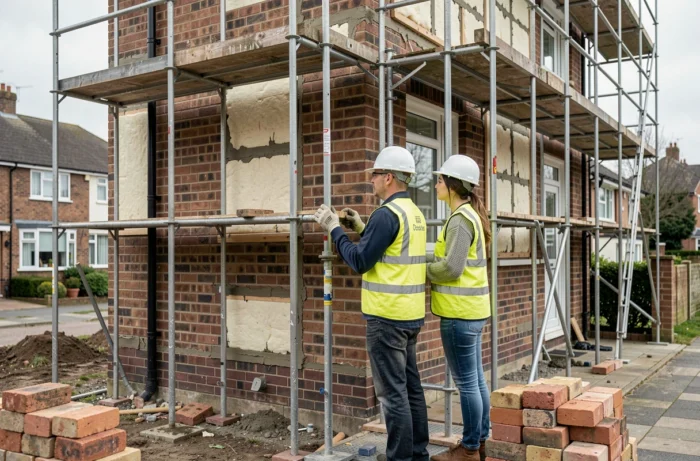
New builds and major renovations: making choices based on your plans
The decision is different for a new build than for a renovation. New construction must meet current thermal standards (RE 2020), which require a high level of energy performance from the outset. The EPC rating is not a concern: the building is designed to meet the required thresholds upon completion.
In a major renovation, the existing structure presents technical constraints (stone walls, an old roof frame, no crawl space) that can make certain work more expensive than in a new build. It is worth comparing the costs of renovating and demolishing and rebuilding when the cost of bringing the property up to code represents a significant proportion of its value.
Timber, bio-based insulation, and material choices
Timber for structural work or insulation (wood fiber, cellulose wadding) is increasingly used in both new-build and renovation projects. These bio-based materials offer thermal and moisture-regulating benefits, but their cost varies depending on local supply chains. Comparing material quotes for the same work package (external wall insulation, for example) helps reveal the actual cost difference between conventional and bio-based solutions.
Whether a home project involves construction or renovation, it is best managed using data rather than intuition. The EPC regulatory timeline, current grant requirements, and itemized cost estimates are the three factors to weigh before signing the first quote.