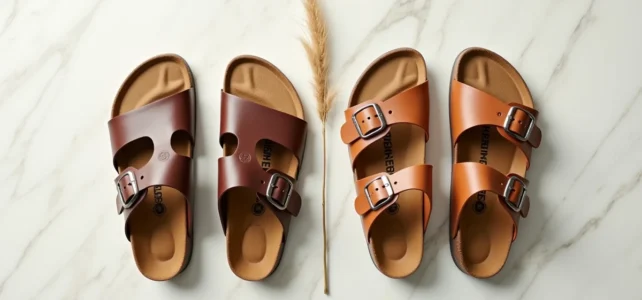
You have been wearing anatomical sole sandals for years, but you have never really known if your pair is from Scholl or Birkenstock. The confusion is common because both brands promise comfort and foot support. However, their approach, materials, and daily performance have little in common.
Rigid sole or flexible sole: the criterion that comparisons overlook
Before discussing style or price, take a closer look at the sole. It determines the sensation underfoot during hours of walking or standing.
You may also like : How to Choose the Ideal Removable Cat Flap for a Rental Patio Door?
Birkenstock uses a cork and natural latex sole that gradually conforms to the shape of the foot. In the first few days, the feel may seem firm, almost hard. The cork then compresses to create a personalized imprint. This breaking-in period can sometimes take several weeks, a detail that many new buyers do not anticipate.
Scholl takes a different approach. Several of its models, notably the Pescura mules, rest on a beech wood base combined with soft cushioning. Comfort is felt from the very first try-on. However, the sole does not deform over time, which means it does not adapt to the individual foot shape.
See also : How to Choose the Right Homologated 125cc Dirt Bike: Essential Tips and Criteria
To delve deeper into Scholl or Birkenstock differences and characteristics, it is essential to start from this distinction between gradual adaptation and immediate comfort. This is the first filter for choice, well before color or model.

Birkenstock Arizona sandals or Scholl Pescura mules: daily use and durability
Have you noticed that a pair of Birkenstock Arizona ages differently than a Scholl mule? The reason lies in the materials and their original purpose.
Birkenstock, designed for prolonged walking
The Arizona model, the brand’s best-seller, combines leather or Birko-Flor on a molded cork sole. The arch is pronounced, and the heel is slightly recessed. This design aims to distribute the body’s weight across the entire surface of the foot.
Podiatrists emphasize that this type of rigid sole can relieve certain pains, especially for people who walk for long periods on hard surfaces. However, relieving is not treating: an anatomical sole does not replace personalized medical advice.
Scholl, designed for static work and indoors
Some Scholl models, which are softer or have wedge heels, appear in guides dedicated to shoes suitable for prolonged standing work. Their flexibility is suitable for indoor or professional environments, where a very rigid sole can tire the foot.
Scholl primarily targets those who stay in place, while Birkenstock targets those who move. This division of use, rarely articulated so clearly, helps in making a choice.
Style and fashion positioning: two trajectories that diverge
Classic comparisons pit comfort against aesthetics. Recent reality is more nuanced. Both brands have evolved in distinct directions in terms of fashion.
- Birkenstock has solidified a “normcore” positioning, bolstered by collaborations with luxury houses and a constant presence in casual fashion. The Boston model, for example, has become an urban classic worn year-round.
- Scholl has taken a more unexpected turn. The brand has collaborated with designers (notably Céline), and its wooden mules are making a comeback in summer fashion selections as a sharp alternative to basic sandals.
- Birkenstock leather ages with a visible patina. Scholl materials, often synthetic in entry-level models, do not age as well but are also cheaper to purchase.
If style is your priority, ask yourself what aesthetic you are aiming for. A minimalist urban look pairs better with a Birkenstock. A more pronounced summer look, with volume on the foot, can benefit from a Scholl Pescura.

Choosing between Scholl and Birkenstock: concrete criteria
Rather than listing generalities, here are the questions that truly filter the choice.
- Will you be walking for more than two hours straight? If yes, the Birkenstock cork sole supports prolonged walking better.
- Do you work standing on a hard floor, indoors? Scholl models with soft or wedge soles absorb shocks better in a static position.
- Are you willing to accept a breaking-in period? Birkenstock cork requires time. Scholl offers comfort felt from day one.
- What budget are you aiming for? Entry-level Scholl models are significantly cheaper. Natural leather Birkenstocks fall into a higher price range, but their durability compensates in the long run.
Neither brand suits everyone. Someone with flat feet will not have the same experience with an Arizona as with a Pescura. The best reflex remains to try both in-store, walking for at least five minutes with each pair.
The difference between Scholl and Birkenstock is not just a matter of brand or price. It relates to the rigidity of the sole, the intended use, and the time you are willing to invest in breaking them in. Starting from your daily lifestyle, rather than a generic comparison, remains the most reliable method to avoid regretting your purchase.