
The job market related to sustainable development is no longer limited to positions such as environmental project manager or renewable energy engineer. The distinction between green jobs and greening jobs reshapes the landscape of opportunities: the majority of recruitments related to ecological transition involve traditional roles that now incorporate climate or environmental objectives.
Measuring this gap between “natively sustainable” positions and those undergoing transformation allows for better guidance in job searching within sustainable development.
Green jobs and greening jobs: two markets with distinct logics
Regional employment observatories clearly distinguish two categories. Green jobs have an explicit environmental purpose: water treatment technician, ecologist, CSR manager, carbon footprint consultant. Greening jobs are traditional roles (purchaser, logistics manager, HR manager, site manager) whose job descriptions are gradually integrating sustainable practices.
This distinction changes the job search strategy. A candidate who only consults specialized environmental platforms misses a significant portion of sustainability-related job offers published on general job boards under titles that do not mention the word “sustainable”.
| Criterion | Green jobs | Greening jobs |
|---|---|---|
| Environmental purpose | Explicit (core of the position) | Integrated into objectives, not in the title |
| Volume of offers | Minority | Majority |
| Distribution platforms | Specialized job boards (environment, ESG) | General job boards, sector-specific sites (construction, industry, logistics) |
| Required skills | Basic environmental expertise | Job-specific skills + climate/environment competency development |
| Dominant contract type | Permanent contracts and project missions | Classic permanent contracts, often in industrial or tertiary companies |
The offers published on ecoemplois.fr cover both categories, providing a more comprehensive view than platforms limited to positions labeled “environment”.
Sectors hiring in sustainable development: renewable energies, renovation, and circular economy
Three sectors concentrate the majority of the pressure on the sustainable job market in France. Their recruitment dynamics differ significantly.
Renewable energies
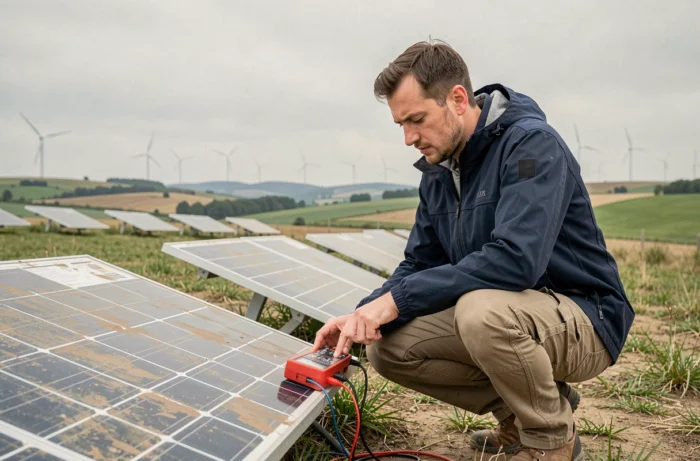
The renewable energy sector (solar, wind, storage) recruits for technical profiles: study engineers, connection project managers, maintenance technicians. The pressure is mainly on experienced profiles capable of managing projects from start to finish, from administrative instruction to commissioning. Positions are distributed between Île-de-France for headquarters functions and coastal or rural regions for operations.
Energy renovation of buildings
The construction sector represents a considerable pool of greening jobs. Companies in the sector are looking for site managers, thermal engineers, and energy auditors trained in new regulations. Skills development on energy performance transforms existing positions rather than creating new ones.
Circular economy and waste management
The sorting, recycling, and reuse sectors are structuring. They hire reverse logistics managers, process engineers, and salespeople specialized in material recovery. Permanent contracts are the dominant contract type for management positions.
Skills sought by recruiters in sustainability
Companies engaged in ecological transition do not recruit solely based on environmental expertise. Profiles that stand out combine solid job-specific skills with the ability to integrate sustainability issues into concrete operational processes.
- Mastery of applicable regulatory frameworks for the targeted sector (building standards, ICPE regulations, European taxonomy for sustainable finance)
- Ability to manage a carbon footprint or life cycle analysis, even in a position that is not labeled “environment”
- Skills in cross-functional project management, as climate objectives involve multiple departments (purchasing, production, HR, finance)
- Aptitude to translate sustainability objectives into measurable operational indicators
A profile that can quantify the impact of a climate action in financial terms has a clear advantage over a candidate limited to qualitative discourse. Recruiters in industry and the tertiary sector seek this dual perspective.

Job search strategy in sustainable development: broaden the scope
Limiting oneself to specialized environmental platforms means ignoring the majority of positions related to ecological transition. An effective search combines multiple channels.
On general job boards (Apec, France Travail), the keywords to combine are “CSR,” “carbon footprint,” “energy performance,” “circular economy,” or “green taxonomy,” associated with the classic job title. An industrial purchaser whose job description mentions “supplier environmental criteria” is a fully greening position.
Sector-specific sites (construction, energy, logistics) publish offers where the sustainable component only appears in the detailed description, not in the title. Filtering solely on “sustainable development” in the search field excludes these positions.
- Combine a specialized environmental job board with one or two general job boards filtered by sustainability keywords
- Monitor offers from B Corp certified companies, labeled Lucie, or engaged in the climate business convention
- Target industrial SMEs in the decarbonization phase, which recruit operational profiles integrating environmental objectives
The ecological transition does not lead to massive job cuts but a need for skills development in virtually all sectors. Rather than searching for a “green” job by nature, it is about identifying companies whose traditional roles integrate sustainability objectives.
The candidate who documents their ability to contribute to this transformation, with concrete deliverables and quantified indicators, positions themselves in a much broader market than just environmental jobs.