
Ceramic beads attract attention with their simple promise: to purify tap water without filters, without waste, without energy. Their popularity is growing in Europe, driven by ecological and economic arguments. But how valid are these claims when looking for measurable evidence of their effectiveness on water quality?
Ceramic beads and water filtration: what comparative analyses show
To position ceramic beads among domestic water treatment methods, a comparison of concrete parameters helps to set the framework. The data below summarizes what emerges from the available technical sources.
You may also like : The best solutions for effective treatment of grape diseases
| Criterion | EM Ceramic Beads | Activated Carbon (Binchotan, cartridge) | Reverse Osmosis Filter |
|---|---|---|---|
| Chlorine Reduction | Claimed by manufacturers, not confirmed by published independent testing | Documented by standards (NSF/ANSI 42) | Documented by standards (NSF/ANSI 58) |
| Hardness Reduction (TH) | No published measurable decrease | Limited or no effect | Significant reduction documented |
| Removal of Contaminants (pesticides, metals, PFAS) | Not documented | Partial depending on cartridge type | Wide spectrum documented |
| Plastic Waste Generated | None | Low (compostable carbon) | Reject water, plastic cartridges |
| Published Independent Tests | No identified | Yes (certified laboratories) | Yes (certified laboratories) |
This table highlights a structural gap. Solutions based on activated carbon or reverse osmosis have standardized and reproducible testing protocols. Ceramic beads, on the other hand, have not undergone any published and reproducible independent testing demonstrating a measurable reduction of contaminants in water.
To delve into the scientific opinions on ceramic beads, it is essential to distinguish between user perception and analytical measurement.
Related reading : Discover the secret coves and beaches of Lake Bourget for an unforgettable summer
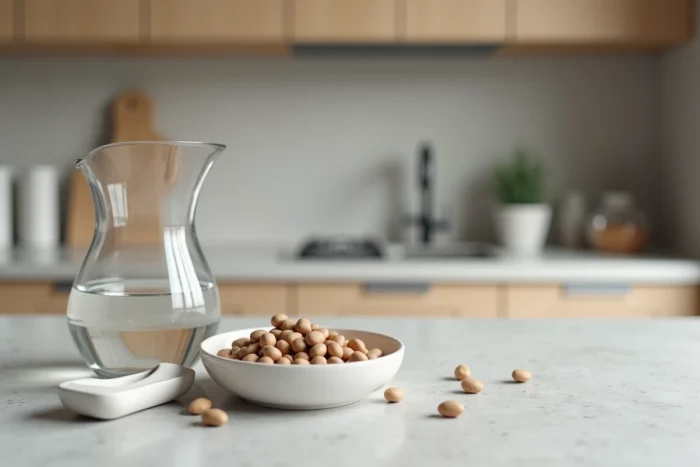
Effective Micro-organisms: The Claimed Principle vs. Scientific Method
The functioning attributed to ceramic beads relies on the so-called effective microorganisms (EM) technology, developed by Japanese doctor Teruo Higa several decades ago. The idea: beneficial bacteria and yeasts are integrated into the clay before firing. After high-temperature firing, the micro-organisms themselves do not survive.
Proponents of the beads claim that the vibrational imprint of the micro-organisms remains in the ceramic and restructures water upon contact. This concept is akin to what the scientific community refers to as “water memory,” a hypothesis formulated in the 1980s and since rejected due to lack of experimental reproducibility.
Why this distinction matters for purification
A water filtration or purification process is validated by a precise protocol: the concentration of a contaminant is measured before and after treatment, with a control group, under controlled conditions. The results are published in a peer-reviewed journal so that other laboratories can reproduce them.
Ceramic beads have no publication meeting these criteria. The data put forward by manufacturers comes from internal tests, without standardized protocol or external verification. No independent laboratory has confirmed the reduction of hardness, nitrates, or pesticides through simple contact with EM ceramic beads.
Water Taste and User Perception: A Real but Limited Effect
Many users report an improvement in the taste of their water after using ceramic beads. This feedback recurs in online testimonials and discussion groups.
This perception should not be dismissed, but it does not constitute proof of purification. Several factors may explain it:
- The simple act of letting water sit in a pitcher allows free chlorine to partially evaporate, improving taste without the intervention of the beads
- The placebo effect plays a documented role in taste perception, especially when the user expects an improvement
- The temperature of the stored water may vary and alter taste perception
Improvement in taste does not mean reduction of pollutants. Water that seems better to the palate may contain exactly the same concentration of nitrates, pharmaceutical residues, or microplastics.
Ecological Benefits of Ceramic Beads: A Valid Argument, Under Conditions
The strongest argument in favor of ceramic beads does not concern purification but rather the reduction of plastic waste. Replacing plastic water bottles with tap water poured into a pitcher with beads effectively eliminates a major source of waste.
Tap water in France is subject to strict health controls and remains potable as is in the vast majority of cases. Ceramic beads can then serve as a psychological trigger: they instill confidence in people who were hesitant to drink tap water and who were buying bottled water.
However, if the goal is to treat water containing specific pollutants (lead from old pipes, pesticides in agricultural areas), ceramic beads do not replace a certified filtration device. Activated carbon or reverse osmosis methods remain the only domestic solutions whose effectiveness is documented by standardized tests.

The question of the effectiveness of ceramic beads boils down to a gap between promise and proof. Their ecological impact through plastic reduction is tangible. Their ability to purify water remains, to date, a commercial claim without independent scientific validation. For those seeking a reliable filtration solution, the data points towards products whose performance has been measured according to recognized protocols.