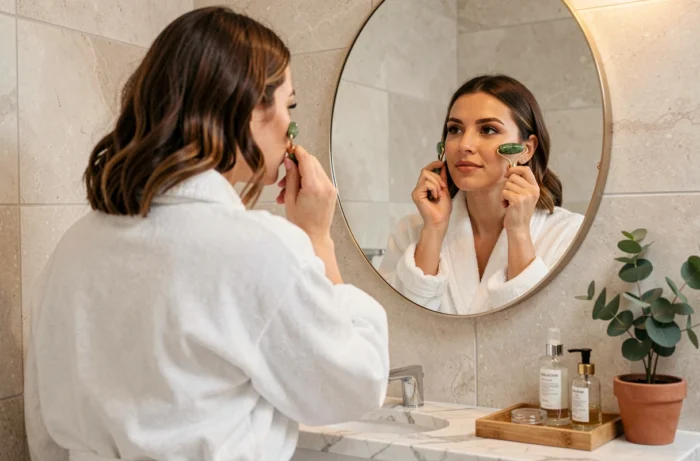
Taking care of your beauty and well-being on a daily basis relies on concrete choices, not on an accumulation of gestures. With the proliferation of cosmetic products, new European regulations on allergens, and the growing influence of algorithms in discovering treatments, the benchmarks are changing rapidly. Measuring what really changes allows you to build a routine suited to your skin and lifestyle.
Cosmetic allergens: what the new European regulation changes for your beauty routine
Regulation (EU) 2023/1545 has expanded the list of fragrance allergens that must appear on labels, increasing from about 24 to around 80 substances to declare. This change directly alters the reading of compositions, including for products marketed as gentle or natural.
This extension includes many natural extracts such as significant oils and absolutes. In practice, a facial treatment labeled “natural” can now display a much longer list of allergens than before, not because its formula has changed, but because regulatory transparency has improved.
For people with sensitive or reactive skin, this evolution is a lever for concrete choice. Reading the label becomes a care gesture in its own right, as useful as applying the product itself. The resources available on beautyhealth.be allow for a deeper exploration of these issues related to ingredients and skin health.

Hydration and nutrition: comparative table of internal and external levers
Beauty routines often focus on topical treatments (creams, serums, oils). Hydration and nutrition work in parallel, with different mechanisms. The table below contrasts the two approaches to clarify their respective roles.
| Lever | Mode of action | Main effect on the skin | Limitation |
|---|---|---|---|
| Internal hydration (water, water-rich diet) | Systemic water supply via the bloodstream | Maintaining elasticity, supporting cell renewal | Does not compensate for a compromised skin barrier |
| External hydration (cream, serum, oil) | Occlusive or humectant film on the surface | Reduction of transepidermal water loss, immediate comfort | Does not correct dehydration related to diet or sleep |
| Antioxidant nutrition (colorful vegetables, fatty acids) | Neutralization of cellular oxidative stress | Protection against premature aging, radiance of the complexion | Visible effects over several weeks, not immediate |
| Targeted nutritional supplements | Concentrated supply of specific micronutrients | Spot support (vitamins, collagen) | Does not replace a varied diet or suitable care |
The main gap lies in the timing. A topical treatment acts within minutes, an internal lever takes several weeks. Combining the two does not double the effect but covers two distinct mechanisms that one alone cannot ensure.
Facial and body care: where to focus your efforts daily
The face represents a smaller surface compared to the rest of the body, but it is the area most exposed to external aggressions (UV, pollution, friction). In contrast, the body generally has a thicker and less reactive skin barrier.
This difference has a direct practical consequence on the daily routine:
- Facial cleansing morning and night remains the gesture with the most documented impact, as it removes accumulated oxidative particles and prepares the skin to absorb a moisturizing treatment
- Exfoliation, often presented as a weekly gesture, should be modulated according to skin type: sensitive skin rarely tolerates more than one exfoliation per week without irritation
- Body hydration after showering, when the skin is still slightly damp, improves the penetration of moisturizing agents compared to application on dry skin
- Facial sun protection remains relevant all year round, not just in summer, as UV rays penetrate clouds and windows
Focusing your efforts on the face in the morning and on the body in the evening avoids the overload of gestures that leads to abandoning your routine after a few weeks.

Algorithms and product discovery: how AI influences your beauty choices
Algorithmic recommendations on shopping platforms and social networks guide the discovery of new brands, particularly in the categories of fragrance, skincare, and makeup. AI is playing an increasingly significant role in building the beauty routines of French consumers.
This phenomenon changes how a routine is constructed. Where choices were made in pharmacies based on packaging or in-store advice, they are now made upstream, through a personalized flow. The dynamics of discovering new brands is accelerating thanks to these targeted digital contents.
This acceleration has a downside. The multiplication of suggestions encourages testing more products, which can destabilize an established routine. An effective product replaced too quickly by an algorithmic novelty does not give the skin time to adapt.
Building a stable routine despite the pressure of recommendations
Keeping a cleansing product and a moisturizer for at least four to six weeks before judging their effectiveness remains a more reliable approach than following every suggestion. The skin’s cell renewal takes several weeks. Changing treatments every ten days prevents any realistic evaluation.
Beauty and well-being on a daily basis depend less on the quantity of products or gestures than on their regularity and their real adaptation to your skin. The new European labeling requirements provide a more precise reading tool for choosing, and maintaining a routine over several weeks remains essential to evaluate its real results.