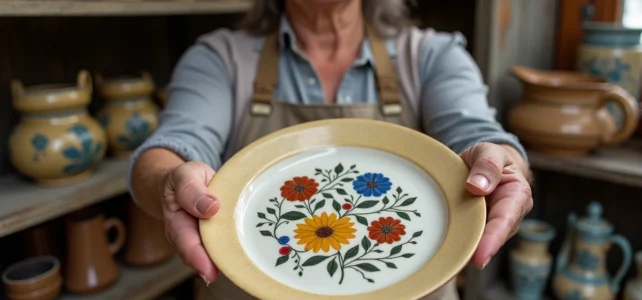
The mark on the back of a Henriot Quimper earthenware piece is not enough to establish a reliable dating. We regularly observe pieces whose stamp corresponds to one period, but whose clay, glaze, or decoration tell a different story. Cross-referencing multiple material clues remains the only solid method to situate a piece in time.
Henriot earthenware marking technique: a frequently overlooked period indicator
The way the mark has been applied serves as a first filter for dating, even before reading what it says. A painted mark under glaze generally indicates an older production, prior to the industrial turning point of the earthenware factory. The pigment, protected by the glassy layer, shows a characteristic slight blur.
Further reading : Tips and Inspirations for Stylishly Decorating and Furnishing Your Home
Conversely, a stamp applied on glaze, with clear and regular typography, points to a more recent manufacture. Marks printed by transfer, with a perfectly homogeneous finish, appear on later series.
A point of caution: overly modern typography, a pigment whose brightness clashes with the general wear of the piece, or an industrial stamp on an object presented as ancient are frequent signals of re-marking or counterfeiting. We recommend systematically comparing the sharpness of the mark with the condition of the surrounding glaze. A visible discrepancy between the two almost always betrays a subsequent intervention.
See also : Tips and Advice for a Fulfilling Family Life Every Day
To deepen this identification work, you can discover how to date a Henriot earthenware piece on Côté Déco by consulting their detailed guide on signatures and production periods.
Henriot Quimper signatures: reading the chronology in the stamp
The Henriot earthenware factory has registered numerous signatures throughout its history, and their chronological classification allows for dating in spans of a few years when one has the right references. Generalist articles distinguish three main phases, but the reality is more granular.
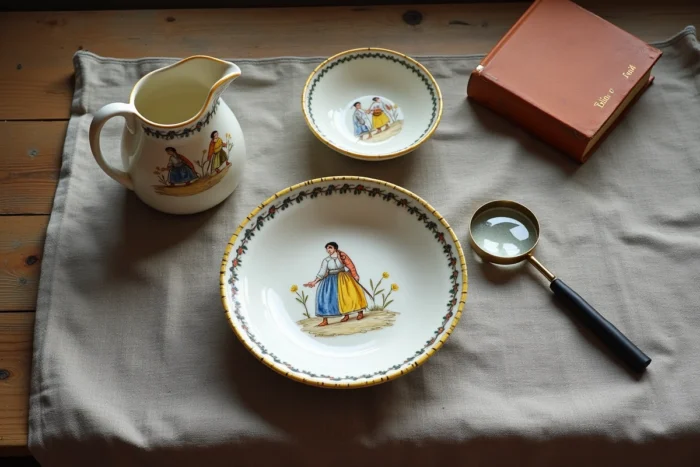
Before 1922, marks often consist of handwritten initials. The script varies from one painter to another, making identification tricky without a reference catalog. The official website of the Henriot-Quimper earthenware factory offers a detailed typology of these old signatures, classified by period.
Between 1922 and 1968, the full name “Henriot Quimper” appears in a more standardized manner. However, the shape of the letters, their size, and their positioning evolve, and these variations constitute exploitable micro-indicators.
After 1968, marks sometimes include codes or serial numbers. The presence of a number does not guarantee age: it indicates, on the contrary, a rationalized production.
- Handwritten initials only, irregular script: production probably prior to 1922
- Name “Henriot Quimper” in full, still partially manual writing: period 1922-1968
- Industrial stamp with standardized typography, possibly accompanied by a code: production after 1968
An artist’s signature (painter or decorator) sometimes complements the trademark. These individual signatures are a valuable dating tool when they correspond to artists whose activity period at the earthenware factory is documented.
Clay, glaze, and Breton decoration: the intersection of material clues
Relying solely on the “Henriot Quimper” stamp or a painted date is a common mistake. The consistency between clay, glaze, style, and wear must be verified to validate a dating.
The clay of older productions often has a slightly creamy hue, with a more granular texture than modern clays. A break or chip allows observation of the cross-section: a pure and homogeneous white points to more recent manufacture.
The stanniferous glaze of 19th-century pieces frequently shows fine crazing (the tressaillage), an irregular network that has aged over time. A crazing that is too regular or absent on a piece presumed to be old should raise alarms.

The decoration itself speaks. The “petit breton” and “petite bretonne” motifs have evolved in their graphic treatment:
- Thick lines and limited colors (blue, yellow, green) on older productions, with a naive rendering and visible brush strokes
- Wider palette and finer details on mid-20th-century pieces, influenced by collaborations with artists linked to the Ar Seiz Breur movement
- Very regular decorations, sometimes close to stenciling, on later series intended for the tourist market
Wear must correspond to the supposed age. A piece presented as dating from the 19th century with perfectly sharp edges and intact glaze deserves closer examination. Contact areas (base, upper edge) naturally accumulate micro-chips over several decades of use.
Henriot earthenware and the collectors’ market: what dating changes
The market for Quimper earthenware has evolved in recent years. Collectors’ interest is increasingly focused on pieces by artists and creations linked to Breton artistic movements, rather than on standard decorative series. This trend alters the notion of “useful” dating: the production period matters less than attribution to an artist or a specific commission.
A Henriot plate from the 1930s signed by an identified decorator from the Ar Seiz Breur movement does not have the same value as a contemporary series piece. Dating alone does not set the price; it is the intersection of period, signature, rarity of decoration, and condition that determines the estimate.
The condition weighs heavily in the evaluation. A chip on the edge, visible restoration, or overly pronounced crazing significantly affects the value, even on an old and correctly attributed piece.
Before concluding on the age of a Henriot Quimper earthenware piece, we recommend systematically photographing the back (mark, tool traces, visible clay color) and comparing with the typologies published by the earthenware factory itself. An expert opinion in Breton ceramics remains the most reliable complement when material clues contradict each other.