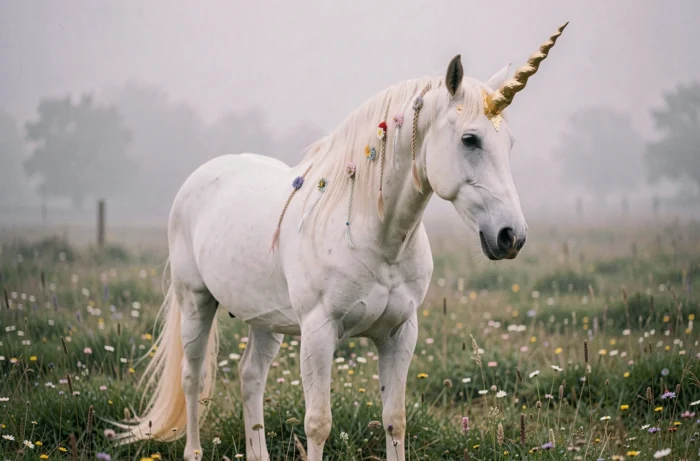
The unicorn occupies a unique place in the collective imagination. A creature with a single horn, part horse and part chimera, it traverses eras and cultures without ever completely disappearing from representations. Its image has, however, undergone profound mutations, evolving from the medieval bestiary to the marketing trends of the 2010s, and then to a marked commercial decline. Understanding what the unicorn symbolizes today requires revisiting these successive shifts.
The unicorn in ancient texts: an animal between zoology and theology
Before being a motif printed on phone cases, the unicorn was first a translation problem. Medieval bestiaries describe it as a wild animal, often associated with the deer or horse, endowed with a horn possessing purifying properties. The BnF holds several illuminated manuscripts where the creature appears alongside real animals, with no clear distinction between the fantastic register and naturalistic observation.
This confusion is not anecdotal. In India, some ancient tales mention animals with a single horn that Western travelers later associated with the European unicorn. The rhinoceros, the narwhal, and even certain species of deer have fueled these cross-descriptions over the centuries.
The religious dimension further complicates the reading. In the medieval Christian tradition, the unicorn represents purity and divine incarnation, captured only by a virgin. This link between purity, femininity, and the horned creature has durably structured the animal’s symbolism, well beyond the Middle Ages. Enthusiasts of objects and stories surrounding this creature can be found on happylicorne.fr, a sign that fascination persists in very contemporary forms.

Unicorn and magic: why the symbol resists rationality
The unicorn has never needed proof of existence to function as a symbol. It is precisely its elusive nature that gives it its imaginative power. Where other mythological creatures (the griffin, the basilisk) have lost their emotional charge, the unicorn retains an intact evocative capacity among a very broad audience.
Several factors explain this persistence:
- The visual simplicity of the figure (a white horse, a horn, sometimes a rainbow mane) makes it immediately identifiable, even to young children.
- Its association with positive magic, without a frightening dimension, makes it a reassuring and inclusive symbol, unlike the dragon or the werewolf.
- The unicorn functions as a marker of imagination and embraced uniqueness, particularly in digital culture where the unicorn emoji is used to express originality or optimism.
The adoption of the unicorn emoji in Unicode (integrated on iPhone since fall 2015) has given the symbol a second digital life. The unicorn has become a visual language in its own right on social media, detached from any mythological narrative, reduced to an emotional function: to express joy, fantasy, and a rejection of the mundane.
Commercial peak and decline: the unicorn as a consumer trend
The shift of the unicorn towards mass marketing accelerated in the mid-2010s. According to data published by EnjoyMedia, the unicorn motif reached its commercial peak around 2016, representing about one unit sold out of eight in certain merchandise catalogs. Floats, clothing, pastries, cosmetics: the rainbow horn was found everywhere.
The decline was equally sharp. Starting in 2019, the share of unicorn products in total sales has decreased each year. In 2023, it fell below the threshold of 0.5% of annual sales, a level deemed residual by industry players. EnjoyMedia explicitly refers to “rise, peak, and end” to describe the trend cycle.
A residual motif, not a dead symbol
This commercial decline does not mean that the unicorn has lost its symbolic charge. It rather indicates that the market has exhausted the novelty of the motif. The unicorn products that remain now target a loyal and specialized audience, often children or dedicated collectors, rather than trend consumers.
The distinction is useful: a cultural symbol and a marketing product do not follow the same cycles. The cross, the heart, the star continue to mean something long after the end of their maximum commercial exploitation. The unicorn follows the same pattern, with a stable symbolic core (purity, imagination, happiness) and a commercial layer that is eroding.
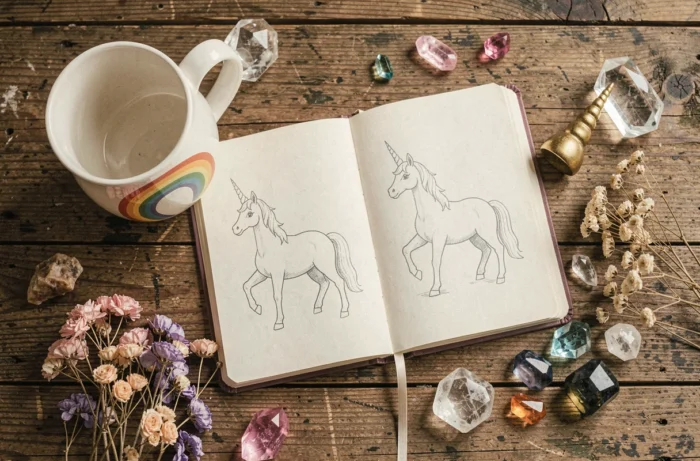
Unicorn and happiness in everyday life: between personal projection and social code
Claiming that the unicorn is a “symbol of everyday happiness” deserves to be examined closely. Happiness is not an intrinsic property of the motif. It is a projection that the public makes onto the creature, mobilizing a network of mental associations: childhood, bright colors, absence of threat, fairy-tale universe.
This mechanism works differently depending on the context. For a child, the unicorn embodies a world where magic exists. For an adult, it may signal a form of self-deprecation or a voluntary attachment to the imaginary, a way to claim a share of fantasy in a normalized daily life.
In recent digital culture, the unicorn also functions as a social code of positive uniqueness. Declaring oneself a “unicorn” or using the motif in personal communication amounts to asserting an optimistic, quirky temperament, resistant to cynicism. Field feedback diverges on the durability of this code: some see it as a generational marker already dated, while others view it as a lasting emotional register.
The unicorn does not promise happiness. It offers a visual vocabulary to express it, claim it, or simply suggest it. It is this signaling function, more than the creature itself, that explains its longevity in contemporary imagination.