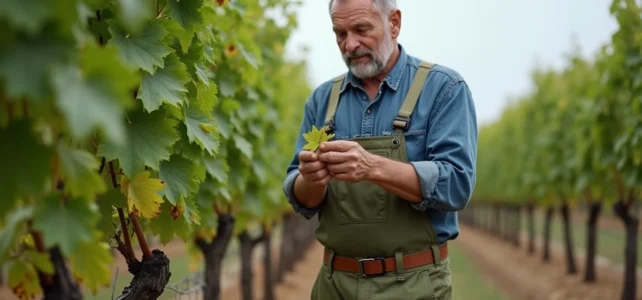
Oily yellow spots on the leaves, a white fluff under the clusters, berries that turn black in a few days: the vine sends clear signals when a disease takes hold. The problem is that several fungi produce similar symptoms at first, and a misdiagnosis leads to ineffective treatment. Choosing the right strategy requires understanding the infection mechanism before reaching for the sprayer.
Alternating active ingredients: the reflex that conditions the entire fungicide program
Have you ever noticed that a treatment works well one year, then seems to lose effectiveness the next? This phenomenon has a name: fungal resistance. The fungi responsible for downy mildew or powdery mildew mutate rapidly when repeatedly exposed to the same molecule.
You may also like : What do experts say about the effectiveness of ceramic beads for water?
Recent technical recommendations emphasize a simple principle: never apply two consecutive treatments with the same chemical family. Specifically, if you use a copper-based fungicide against downy mildew, the next application should use a different active ingredient.
To structure a truly sustainable treatment for grape diseases, one must think in terms of a seasonal program, not isolated interventions. Alternation also applies to anti-powdery mildew treatments: alternating sulfur and synthetic fungicides reduces the selection pressure on fungal populations.
See also : Discover the secret coves and beaches of Lake Bourget for an unforgettable summer
This logic of alternation does not complicate the treatment schedule. It structures it. A tracking notebook noting each active ingredient used at each application is sufficient to avoid repetitions.
Downy mildew and powdery mildew: two fungi, two approaches
Downy mildew (Plasmopara viticola) and powdery mildew (Erysiphe necator) are the two most common fungal threats to vines. Their development conditions differ, and confusing them amounts to treating blindly.
Recognizing downy mildew on leaves and berries
Downy mildew first appears as oily yellow spots on the upper side of the leaves. When turning the leaf over, a white fluff appears in humid weather. On the clusters, the attack can cause brown rot (hard, brown berries) or gray rot (soft, grayish berries).
This fungus needs simultaneous warmth and humidity to spread. It survives in the soil as oospores during the winter and resumes its cycle in the spring as soon as conditions become favorable again.
Bordeaux mixture remains the reference preventive treatment against downy mildew, usable in organic farming. It acts as a contact barrier on the leaves, preventing spores from germinating. Its effectiveness depends on the timing of application: before the rain, not after.
Identifying powdery mildew and choosing the right product
Powdery mildew is identified by a floury white powder covering the leaves, shoots, and berries. Unlike downy mildew, it does not require rain to develop. A confined atmosphere and moderate temperatures are sufficient.
Sulfur is the classic treatment against powdery mildew, effective both preventively and at the onset of an attack. It works by contact and vapor, making it particularly suitable for vines trained in trellis or goblet systems. Applying sulfur in hot weather increases its action through volatilization, but be cautious of leaf burn beyond high temperatures.
Agronomic measures before fungicides: what really changes pest pressure
Recent viticultural technical bulletins converge on one point: airing the plant cover reduces fungal pressure more sustainably than increasing the number of treatments. Dense and poorly ventilated foliage creates an ideal humid microclimate for downy and powdery mildew.
Even before planning fungicide applications, several agronomic practices can reduce the risk of disease:
- Uplifting and training the shoots allow air to circulate in the cluster area, speeding up the drying of the foliage after rain
- Canopy management removes excess shoots and limits shading that promotes fungal sporulation
- Targeted leaf removal around the clusters exposes the berries to light and reduces residual humidity
- Managing vigor through controlled cover cropping between rows limits excessive foliage growth
These practices do not replace fungicide treatments in high-pressure regions, but they reduce the number needed. A well-managed cover can make the difference between five and eight applications in a season.
Black rot and gray rot: two grape diseases often detected too late
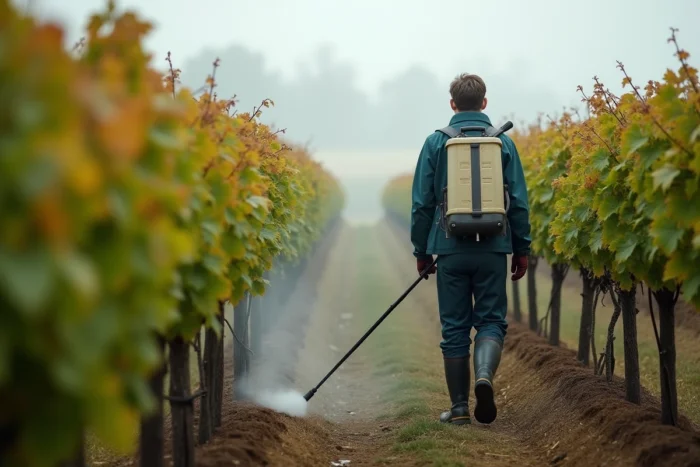
Black rot causes brown spots bordered with black on the leaves, followed by berries that mummify and turn black. This fungus (Guignardia bidwellii) survives on mummified berries left on the ground or on the vine. Removing these mummies in winter is the most effective preventive measure against black rot.
Gray rot (Botrytis cinerea) primarily attacks tight clusters where moisture stagnates. The berries are covered with a characteristic gray fluff. Unlike noble rot sought for certain sweet wines, this form destroys the sanitary quality of the harvest.
For both diseases, the main lever remains prophylactic: eliminate harvest residues, aerate the clusters, avoid mechanical injuries to the berries that create entry points for fungi.
Flavescence dorée: a unique wood disease with no curative treatment
Flavescence dorée is distinct from all the previous fungal diseases. It is a phytoplasma disease, transmitted by a vector insect (the leafhopper Scaphoideus titanus). The leaves curl, the wood does not mature, and the vine deteriorates within a few seasons.
No fungicide can cure it. Control relies on prevention:
- Use certified plants disinfected by hot water treatment before planting
- Quickly uproot infected vines to limit spread
- Apply insecticide treatments targeting vector leafhoppers during flight periods
- Clean pruning equipment between plots to avoid cross-contamination
Recent work in Europe emphasizes the organization of interventions: work first in healthy plots, then in affected plots, never the reverse.
Treating vine diseases is not just a list of products. The choice of the right strategy depends on the diagnosis made in the field, the health history of the plot, and the ability to combine agronomic practices and chemical interventions at the right time. A program that alternates active ingredients and relies first on airing the cover better protects the harvest than a rigid calendar applied without prior observation.