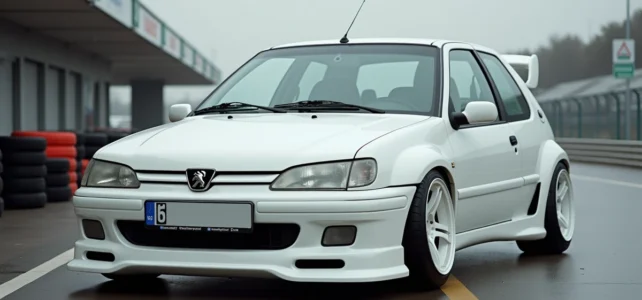
The Peugeot 306, celebrated for its rally pedigree, remains one of the most popular bases for track day enthusiasts in France. The maxi kit, which replicates the body wideners of the Peugeot Sport 306 Maxi, is a dream come true. But between aesthetics and the actual demands of a track, the question must be asked: does this kit change anything about access to amateur driving, or is it merely a visual pleasure?
Amateur track requirements vs. 306 maxi kit: the comparison
Leisure driving circuits in France apply regulations focused on safety, not on bodywork. The regulations of the Circuit de Bresse, representative of most French facilities, illustrate this gap between what amateur drivers imagine is necessary and what is actually required.
Further reading : The best solutions for effective treatment of grape diseases
| Criteria | Amateur circuit requirement | Contribution of the maxi kit |
|---|---|---|
| Covered wheels | Mandatory | Not necessary (the original fenders are sufficient) |
| Noise level | Limited (varies by circuit) | No effect |
| Towing hook | Mandatory | No effect |
| Approved helmet | Mandatory | No effect |
| Liability insurance | Mandatory | No effect |
| Body modifications | Not required | Purely aesthetic |
A stock 306 with its original fenders meets all the conditions for access to free driving. The maxi kit does not appear in any leisure circuit regulations as a prerequisite.
This table is based on documented requirements for car track rights. You can learn more on Passion Auto Méca to delve deeper into this analysis.
Further reading : Foolproof Tips for Reheating Your Lasagna in the Oven Without Drying It Out
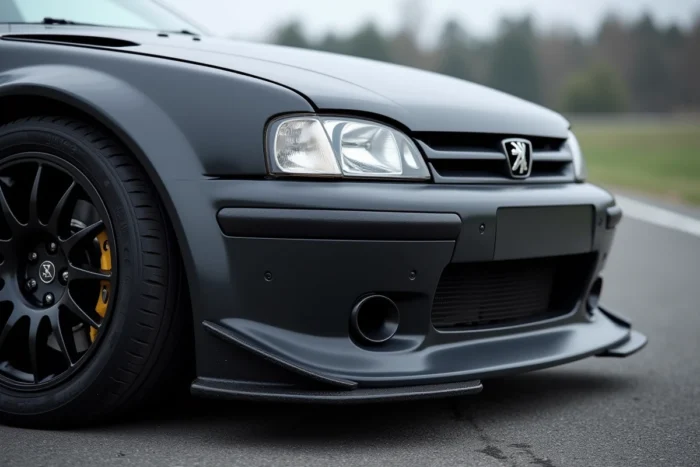
306 maxi kit and homologation: a risk in historic rallying
Free track driving and FFSA events (historic rally, hill climb) do not follow the same rules. This distinction is often misunderstood by 306 owners considering a switch from one use to the other.
The HTP technical passport, a strict constraint
In historic rallying, the vehicle must correspond exactly to its technical passport (HTP). Installing a maxi kit on a stock 306 creates an inconsistency with the original HTP. The maxi kit can become a reason for non-compliance in historic competition, which is paradoxical for a part intended to bring the car closer to the racing version.
For a 306 entered in historic rallying, the configuration must faithfully reflect a documented specification. Adding Maxi body elements to a model that has never been homologated in this configuration poses a concrete regulatory problem.
Free circuit: no technical passport required
In leisure driving, no technical passport is required. Therefore, the maxi kit poses no administrative issues in this context. However, if the goal is to eventually migrate to regulated competition, it is better to check HTP compatibility before any body modifications.
306 track driving budget: where the money really goes
The budget allocated for a maxi kit (parts, paint, installation) represents a significant expense. For an amateur starting out on the track, this same budget can have a measurable effect on safety and driving pleasure if redirected towards other areas.
- Track-appropriate semi-slick tires: they radically change the car’s behavior in corners and under braking, where road tires quickly reach their limits
- Bleeding and upgrading the braking system: sport pads, high-temperature fluid, aviation hoses, to withstand repeated sessions without fading
- Safety roll cage: not mandatory for free driving on most circuits, but highly recommended and sometimes required for certain guided days
- Harness and bucket seat: improve driver support and steering precision, in addition to passive safety
Tires and braking transform track behavior, unlike the maxi kit, which does not alter grip or deceleration. An amateur driving with road tires and stock brakes on the track reaches mechanical limits long before worrying about aerodynamics.
Aerodynamics of the 306 maxi kit: real effect on track
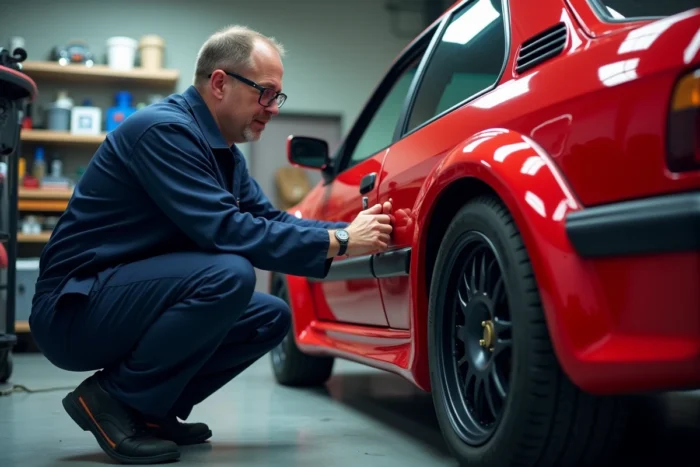
The maxi kit widens the fenders and modifies the front bumper. On the competition 306 Maxi, these wideners allowed for fitting wider wheels and tires, increasing the contact patch with the ground. The aerodynamic gain from the kit alone, without modifications to the running gear or wheels, remains marginal.
Without wider wheels and tires, the maxi kit offers no mechanical gain on the track. The body extensions even create a slight extra weight and additional aerodynamic drag if the space under the fenders remains empty.
On the original Peugeot Sport version, the whole formed a coherent system: wideners, wider track, competition tires, adapted suspensions. Replicating only the outer shell without the rest amounts to copying the appearance without the function.
Driving a 306 on an amateur track: the maxi kit remains an aesthetic choice
The data converge towards the same conclusion. The maxi kit for the Peugeot 306 does not meet any technical requirements of amateur driving circuits. It neither improves safety, nor performance, nor access to track days. Its interest is visual and emotional, which has its value, but not that of driving equipment. For a limited budget, tires, braking, and passive safety produce tangible results from the very first session.