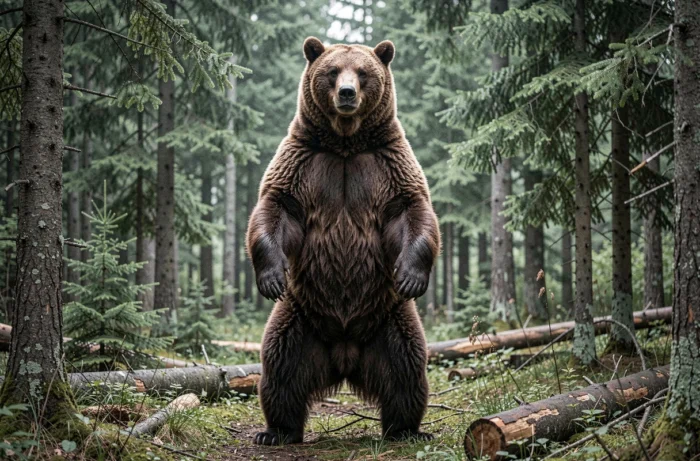
The grizzly and the kodiak both belong to the species Ursus arctos, the brown bear. Their confusion is common, including in popular literature. The distinction is based on ancient geographical isolation, divergent dietary adaptations, and a genetic trajectory that clearly separates an island population from a heterogeneous continental group.
Continental ecotype versus isolated island population: the true taxonomic divide
The classification of the grizzly as a unique subspecies (Ursus arctos horribilis) simplifies a more complex genetic reality. Recent population genetics work shows that continental grizzlies, whether they live in Yukon, the Rockies, or the southern coast of Alaska, do not form distinctly separate subspecies but ecotypes adapted to different environments: salmon-rich coasts, alpine tundra, dry boreal forests.
The kodiak (Ursus arctos middendorffi) occupies a distinct taxonomic position. Its population, confined to the Kodiak archipelago, has been genetically isolated since the end of the last glaciation. Genetic connectivity with brown bears on the continent is virtually nonexistent. We thus observe a case of prolonged insularity that has produced measurable morphological divergence, without crossing the threshold of a separate species.
To delve deeper into the difference between grizzly and kodiak morphometrically, size remains the most visible marker of this divergence, but it is only a consequence.
This genetic homogeneity of the kodiak has a downside: reduced allelic diversity, which makes this population potentially more vulnerable to environmental changes than continental grizzlies, which are more genetically mixed.
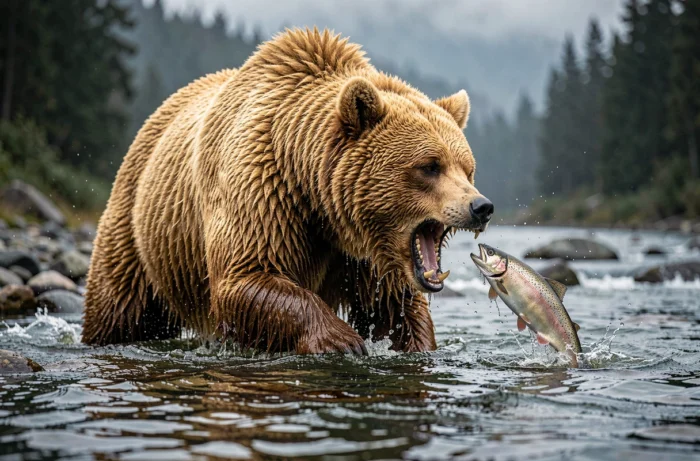
Diet of the kodiak and grizzly: salmon isn’t everything
The superior size of the kodiak is not an evolutionary accident. It results from prolonged access to high-energy marine resources. In the Kodiak archipelago, the availability of salmon spans a longer period than in most continental watersheds. Stranded marine carcasses, dense coastal vegetation, and berries complement a diet that maintains a high caloric intake over several months.
Interior grizzlies in Alaska or the Canadian Rockies face a shorter food window. Their diet, often more omnivorous than strictly piscivorous, includes roots, tubers, insects, small mammals, and ungulate carrion. A coastal grizzly from British Columbia, which also benefits from salmon runs, reaches significantly higher body masses than an interior grizzly, without being a kodiak.
This dietary plasticity illustrates the concept of ecotype: the environment shapes morphology more than genetics alone.
Hibernation and winter rest: variable durations depending on climate
The kodiak hibernates at lower altitudes and for often shorter durations than interior grizzlies. The oceanic climate of the Kodiak archipelago, with its relatively mild winters, reduces the need for prolonged hibernation. Food remains accessible later in the fall and reappears earlier in the spring.
Continental grizzlies, facing harsh winters at higher elevations, enter dens earlier and do not emerge until the snow cover recedes sufficiently. The duration of winter rest can vary by several weeks between a coastal kodiak and a grizzly in the Rockies at the same latitude.
This difference has direct consequences for reproduction. Kodiak females, spending less time in dens, have a longer active season to accumulate the reserves necessary for gestation and nursing cubs.
Population density and species management on the Kodiak archipelago
The Kodiak archipelago has one of the highest densities of brown bears in the world. This island confinement poses specific management challenges. Interactions between bears and human activities (commercial fishing, municipal landfills, housing) are common. Recent reports indicate that bears continue to frequent Kodiak landfills despite plans put in place by state authorities to keep them away.
Continental grizzlies, spread over much larger territories (from Alaska to the Montana Rockies), pose different coexistence issues. The debate over their status under the Endangered Species Act remains heated, with some states pushing for a withdrawal of federal protection in favor of local management.
- The kodiak lives in a confined space with a high density of conspecifics, which promotes a high social tolerance at fishing points.
- The continental grizzly occupies much larger home ranges, with more pronounced territorial behaviors outside of food concentration areas.
- Management of the kodiak depends almost exclusively on Alaska authorities, while that of the grizzly involves several states, Canadian provinces, and federal agencies.
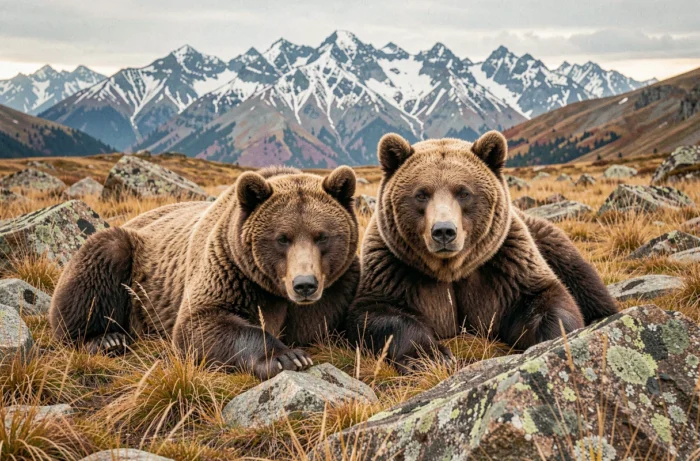
Comparative morphology: beyond mere weight differences
Reducing the comparison to a weight difference between grizzly and kodiak obscures structural differences. The kodiak has a wider skull, a proportionally less prominent dorsal hump than some interior grizzlies, and more massive hind legs.
The dorsal hump of the grizzly is a muscular mass adapted for digging, an important activity for a bear that digs up roots and rodents in hard soils. The kodiak, whose diet relies more on fishing and coastal foraging, does not have the same muscle demands.
Another rarely mentioned point: claw size. Interior grizzlies have proportionally longer and more curved claws, adapted for digging. Those of the kodiak, while formidable, are often shorter and straighter, a profile associated with less intensive digging use.
- Kodiak skull wider in proportion, reflecting a powerful jaw adapted for crushing marine carcasses.
- Grizzly claws longer and curved, optimized for digging in hard ground.
- Kodiak females are heavier than male grizzlies from some interior populations, blurring simplistic comparisons based on sex.
The distinction between grizzly and kodiak goes beyond the simple postcard of the “biggest bear.” It raises questions of insularity, ecological plasticity, and wildlife management that touch on conservation biology as a whole. Classifying these animals in the same mental category ignores what several thousand years of isolation produce on a population of large carnivores.