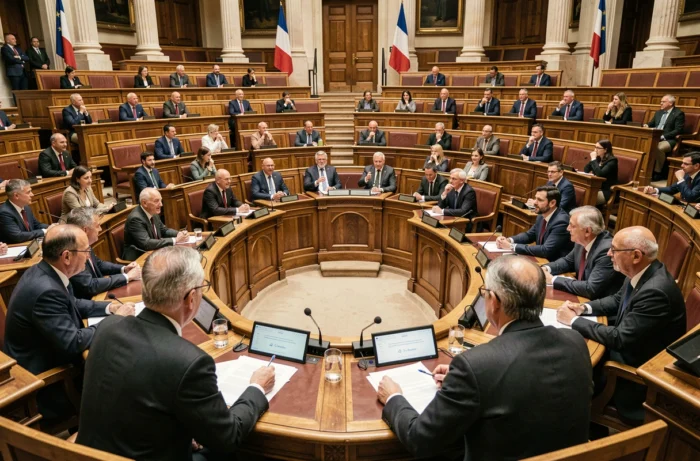
The French political return of summer 2026 is structured around two files with very different logics. On one side, the constitutional censorship of the law on social networks and minors raises the question of legal calibration between child protection and fundamental freedoms. On the other, the rise of summer universities of the parties, less than a year before the 2027 presidential election, accelerates repositioning.
Constitutional Censorship and Social Networks: The Data from the Decision of August 14, 2026
Decision No. 2026-911 DC of the Constitutional Council, rendered on August 14, 2026, invalidated the ban on social networks for those under 15 years old. The table below summarizes the key points of this legislative sequence and its immediate aftermath.
| Element | Content |
|---|---|
| Censored Text | Proposed law on the ban of social networks for those under 15 years old |
| Main Reason for Censorship | Systematic age verification deemed disproportionate (infringement on freedom of expression and privacy) |
| Legal Framework Invoked | Fundamental rights, protection of minors, proportionality |
| Reaction from the Élysée | Rewriting requested from Sébastien Lecornu, alignment with the European Digital Services Act |
| Stated Horizon | New “legally robust” version by spring 2027 |
Several media outlets, including LCP, Numerama, and Le Figaro, published detailed analyses the following day. The Constitutional Council did not reject the principle of online protection for minors, but the method chosen to verify the age of all users. This nuance is crucial for the continuation of the legislative process.
The information relayed on the Les Patriotes website puts this censorship in perspective with other decisions made on the same day, particularly regarding assisted dying and agricultural emergencies, illustrating the intensity of the summer constitutional calendar.
Law on Social Networks and Minors: What the European Alignment Changes
The order given by Emmanuel Macron to his Prime Minister is not limited to a simple tidying up of the censored text. The Élysée explicitly mentioned the Digital Services Act (DSA) and European regulations on the protection of minors online as a reference framework for the rewriting.
This choice alters the logic of the forthcoming text. The initial law relied on a national identity verification mechanism. The new version will have to rely on systems compatible with European law, which significantly restricts the available technical options.
- The DSA already imposes transparency and moderation obligations on platforms, but without a generalized age control mechanism
- The European regulations under discussion on the protection of minors favor proportionate verification solutions, without systematic collection of identity data
- The “spring 2027” horizon coincides with the presidential campaign, which strongly politicizes the legislative calendar
Mediapart described the situation as a legislative “dead end,” emphasizing that the government faces a strong legal constraint without a consensual technical solution. France 24 and Euronews, for their part, insisted on the European dimension of the issue, which far exceeds the Franco-French framework.
Presidential Election 2027: Summer Universities and Back-to-School Positioning
The second issue of late August 2026 concerns the structuring of the political landscape less than a year before the election. According to Le Figaro, most of the candidates for the Élysée will be present at the summer universities organized between August 27 and 30, marking the real start of the campaign.
Édouard Philippe has chosen Mayotte to raise the tone on immigration, even inviting Jean-Luc Mélenchon to come and witness the “migrant crisis” on site. This strategic trip positions the former Prime Minister on ground typically occupied by the radical right.
Le Figaro also reports an electoral erosion phenomenon on the right: an older and more educated electorate, traditionally anchored on the right, is increasingly tempted by the National Rally. The analysis mentions June 2024 as a turning point, when “the dikes broke.”
On the other hand, among the ecologists, Marine Tondelier advocates for “unity” in front of divided activists. The left remains fragmented on the alliance strategy to adopt for 2027.
Access to Care and Maisons France Santé: A Deployment Under Tension

The third structuring issue of the news concerns the network of Maisons France Santé. 1,443 houses have been labeled against a stated goal of 5,000. The pace of deployment, although accelerated in recent months, remains below initial forecasts.
This gap between ambition and realization reveals the persistent tensions regarding access to care in France, particularly in rural areas and territories under-equipped with healthcare professionals. The France Santé label aims to structure a network of local care, but the constraints of medical recruitment hinder the scaling up of the system.
Participatory Democracy: The Citizen Conventions in Question
The final axis of this return is the place of citizen conventions in the democratic debate, which is the subject of parallel initiatives. The newspaper La Brèche describes these devices as a “pillar of democratic renewal,” while citizens like Benoît Mathieu, reported by La Dépêche, are cycling across France to “bring democracy back to the center of the debate.”
The Citizen Convention for Democracy, supported by Missions Publiques, attempts to formalize this movement. These participatory approaches remain marginal in the institutional calendar, but they feed a deep reflection on political representativeness as 2027 approaches.
Summer 2026 will thus have combined constitutional censorship, partisan repositioning, and tensions over public services. The common thread remains the 2027 presidential election, which transforms every legal decision or summer trip into a campaign act. Spring 2027 will concentrate the deadlines: new law on social networks, assessment of Maisons France Santé, and clarification of electoral alliances.