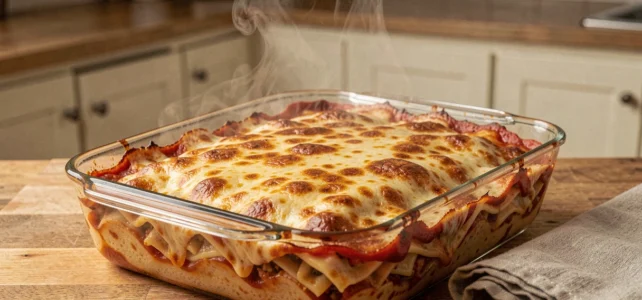
We take the dish out of the refrigerator, slide it into the oven, and twenty minutes later the edges are cardboard while the center remains lukewarm. This scenario is something almost everyone has experienced with leftover lasagna. The problem doesn’t lie with the dish or the original recipe, but with how heat reaches the different layers of pasta, sauce, and cheese. A few precise adjustments can completely change the outcome.
Temperature and resting before cooking: the duo that avoids thermal shock
The classic reflex is to put the dish in the oven directly after taking it out of the refrigerator. This is the first mistake. A cold dish placed in a hot oven creates a brutal temperature gap: the edges heat up quickly, the center barely warms, and we end up extending the cooking time until the surface dries out.
Related reading : Tips and advice for recognizing the age of your vintage Henriot Quimper ceramics
Taking the dish out 15 to 30 minutes before putting it in the oven allows the lasagna to come closer to room temperature. The heat then distributes much more evenly, and the total reheating time decreases.
In terms of thermostat, the most reliable range is between 140 °C and 180 °C. You can fine-tune according to the goal: around 150-160 °C to prioritize softness, 170-180 °C if you want to achieve a bit of a golden crust on top. Beyond that, the cheese burns before the center is hot. You can also reheat lasagna in the oven with Toutes Les Recettes by following a detailed protocol that confirms these temperature guidelines.
Recommended read : Tips and Inspirations for Stylishly Decorating and Furnishing Your Home
Aluminum foil and moisture addition: protecting the surface of the lasagna
Covering the dish with aluminum foil before putting it in the oven is not just a simple grandmother’s tip. The aluminum traps the steam escaping from the internal layers, and this steam maintains the hydration of the pasta and béchamel on the surface. Without this barrier, water evaporates from the top within the first few minutes, and this is precisely what gives that dry and crunchy texture that no one is looking for.
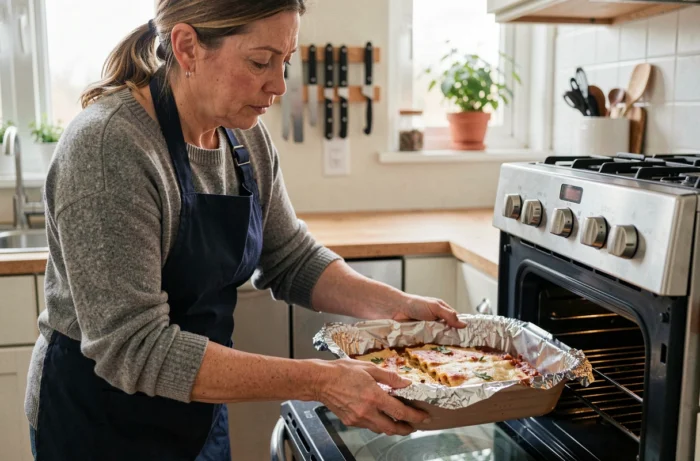
The aluminum stays in place for most of the reheating. It is only removed a few minutes before the end, just enough time for the cheese to brown slightly. This late removal makes all the difference between a golden top and a charred one.
Adding liquid during cooking
If the surface appears dry halfway through (which is common with lasagna stored for more than 24 hours), you can intervene without ruining everything. A few tablespoons of water, broth, or tomato sauce spread over the top, just before replacing the aluminum, is enough to restart the hydration. The liquid generates additional steam that penetrates the upper layers.
Broth adds a slight flavor boost compared to just water. A leftover béchamel sauce works very well too, especially on vegetarian lasagna where the top layer is often thinner.
Adapting reheating according to the state of the dish: refrigerated or frozen
You don’t reheat lasagna from the refrigerator the same way you do frozen lasagna. The time in the oven varies significantly, and getting this wrong leads either to drying out or to the infamous cold center.
- Refrigerated lasagna: after resting outside the fridge, count about 45 minutes in a preheated oven at 180 °C, covered with aluminum. Remove the foil for the last 5 minutes.
- Frozen lasagna: the time increases to about 90 minutes at 180 °C, still with aluminum. Some prefer to defrost it the night before in the refrigerator to revert to the protocol for refrigerated lasagna, which reduces the risk of overcooking the edges.
- Individual portions: a single serving reheats much faster than a whole dish. Reduce the time by a good third and monitor from the twentieth minute.
Feedback varies on the question of prior defrosting: some find that going directly from the freezer to the oven gives better browning, while others notice a still lukewarm center despite extended time. Testing on a portion before reheating a whole dish for a meal with guests remains the safest method.
Reheating in a skillet and microwave: when the oven is not an option
The oven gives the best results, but it takes time and energy. For a single portion on a weeknight, there are two alternatives.
The skillet with a lid
Place the portion in a non-stick skillet over low heat, add a tablespoon of water to the bottom, and cover. The steam trapped under the lid reheats the top while the bottom regains crispiness from contact with the skillet. Count about ten minutes while checking regularly.
The microwave with a glass of water
The microwave has a bad reputation for lasagna because it dries out the pasta on the surface. A simple workaround: place a small container of water next to the plate inside. The water absorbs some of the waves and generates steam, which limits moisture loss. Heat in two-minute intervals at medium power, checking the center between each cycle.
This method will not replace the oven for a whole dish or for achieving a crispy gratin. It is just a quick fix.
Preparing your lasagna in advance for better reheating
Reheating also depends on the assembly. A few choices during the initial preparation make it easier to reheat the next day.
- Finish with a layer of sauce (béchamel or tomato) rather than just cheese. The sauce forms a protective film that limits evaporation during reheating.
- Add enough grated cheese: a thick layer of cheese melts better than a thin layer that dries out.
- Lightly undercook the lasagna during the first cooking if you know they will be reheated. The pasta finishes cooking during the second pass in the oven without becoming mushy.
These adjustments require no additional ingredients. You simply adapt the process knowing that the dish will go into the oven twice instead of once.
The key ultimately lies in three points: a reduced temperature gap at the start, a moisture barrier during heating, and a cooking time calibrated according to the state of the dish. With these adjustments, the lasagna from the next day often rivals that of the day before, sometimes even better, once the flavors have had time to meld during resting.