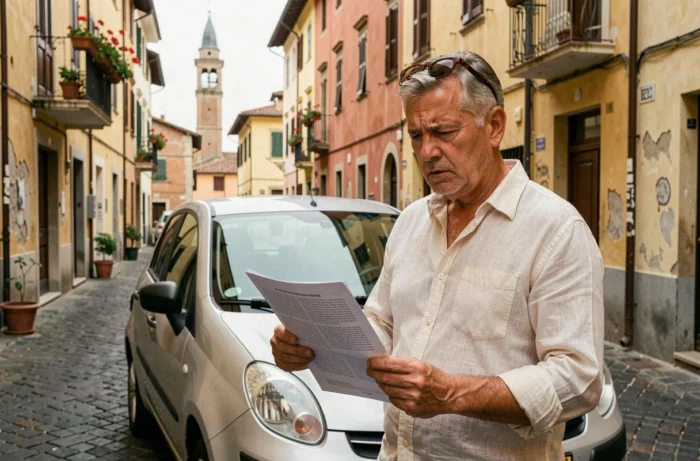
We just returned from a road trip in Tuscany, and three months later, a letter demands payment of a fine for a traffic violation in Italy. The reflex: pay quickly to avoid trouble. This is exactly what the fake tickets aim for, targeting French drivers each year after a car trip across the Alps.
Notification period for Italian fines: why a late letter is not necessarily a scam
A ticket received ten months after a trip seems suspicious. One imagines a scammer trying their luck long after the facts. In reality, the Italian Highway Code allows authorities a period of 360 days to notify a driver residing abroad, compared to 90 days for an Italian resident.
This discrepancy is explained by the procedure for identifying the vehicle owner through foreign registration files, followed by international postal delays. Receiving a notice of violation almost a year after your stay can therefore be perfectly legal.
Scammers precisely exploit this gray area of time. They rely on the fact that the driver, destabilized by an old letter, will pay without checking. First and foremost, one can find out how to recognize a fine scam in Italy to distinguish a regular procedure from an attempted fraud.

Check the sender of the letter: collection agency or municipal police
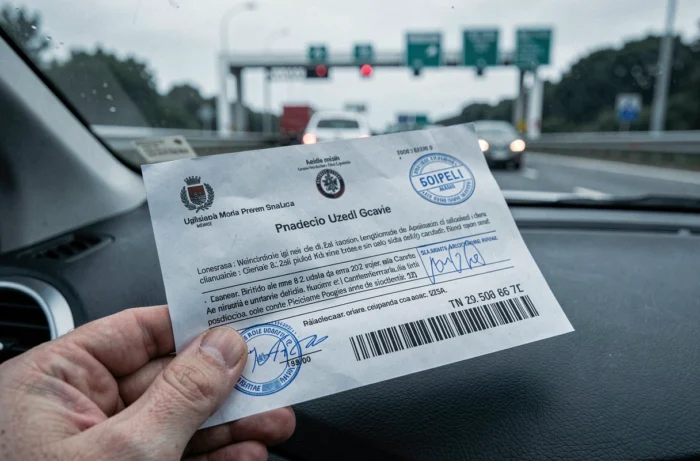
The first thing to check on a notice of violation is the identity of the sender. A real Italian ticket comes from a public authority: municipal police (Polizia Municipale), carabinieri, or the municipality itself. The document bears a report number, the contact details of the issuing authority, and a reference to the Italian Highway Code (Codice della Strada).
Fraudulent letters often come from private collection agencies like NIVI S.p.A., which present themselves as representatives of an Italian municipality. Their real power is limited: a civil collection agency cannot initiate criminal proceedings or seize property in France.
Points to check on the received document
- Does the header mention an Italian public authority with an official protocol number, or just a private business name (S.p.A., S.r.l.)?
- Is the letter sent by registered mail with acknowledgment of receipt? Real tickets sent abroad generally go through registered mail or judicial cooperation channels.
- Does the amount requested correspond to known scales of Italian violations, or is it an unusual round figure accompanied by opaque processing fees?
- Does the document include an official translation or at least a summary in French, as required by European cross-border cooperation?
If the letter does not check these boxes, it is probably an attempt at abusive collection rather than a genuine administrative fine.
Limited traffic zones in Italy: the recurring trap of ZTL for tourists
The majority of fines received after a stay in Italy concern limited traffic zones (ZTL). Florence, Rome, Milan, Bologna: these cities restrict car access to their historic centers at certain times, and cameras automatically photograph unauthorized plates.
The problem for French tourists: ZTL signage varies from city to city. Some signs are discreet or obscured, and the restriction times change depending on the day of the week. One can enter a ZTL without even realizing it, and then receive multiple fines for each passage recorded by the cameras.
Each unauthorized entry into a ZTL generates a separate fine. A driver who crosses a restricted area both to and from on the same day receives two fines. Over a stay of several days, the bill can escalate very quickly.
Concrete precautions before driving in Italian city centers
Checking the active ZTL on the website of the visited municipality remains the most reliable reflex. Public GPS applications do not always accurately signal these zones, and feedback on this varies by city. Parking the car on the outskirts and using public transport in the historic center avoids the problem at its source.
European Directive 2015/413 and cross-border collection: what has changed
The European Directive 2015/413 organizes the exchange of information on traffic violations between member states. Since its amendment at the end of 2024, cross-border collection of traffic fines has been strengthened. Italian authorities can now more easily identify the holder of a vehicle registered in France.
This strengthening means that ignoring a real Italian ticket carries more concrete risks than before. A fine issued by a public authority can, in theory, be subject to a collection procedure through European mutual assistance mechanisms.
In contrast, a private collection agency does not benefit from these official channels. It cannot seize a French bank account or register a debt in the payment incident file. Only an enforceable judicial decision can compel a French resident to pay a debt owed to a foreign private operator.
Disputing or ignoring a fake Italian ticket: what strategy to adopt
Faced with a suspicious letter, the temptation is to not respond at all. If the sender is a private company and the letter is not registered, this approach remains the most common among affected drivers. One does not validate any contact, does not provide any personal data, does not click on any online payment links.
- Never pay via a link received by email or regular mail without having verified the authenticity of the ticket directly with the relevant Italian municipality.
- If the letter is registered and comes from a public authority, check the protocol number on the official website of the municipality or contact the Italian consulate in France.
- Keep all documents received (envelope, letter, any emails) as evidence in case of future disputes.
A real ticket deserves a structured response, whether it be payment or a formal dispute within the deadlines set by Italian law. A fake ticket, on the other hand, deserves neither money nor attention. The challenge is to make the distinction before acting, and it is precisely this initial verification that protects the driver.